
The strange, surprising and very human stories hiding behind the places you’re already going.
Worth Repeating - barcelona
Saints, skulls, scandal, architectural obsession and a city that has never been particularly interested in behaving.
Barcelona
Story Guide
A location-first companion to fake medieval bridges, revenge carvings, martyrdom geese, a hidden math problem and Rome jammed inside a courtyard.
Map = where the story lives.
Barcelona is the end of the route — where the Mediterranean trade, the Roman grid, the medieval Gothic Quarter, the Islamic interlude, the Crown of Aragon's empire and Modernisme all exist within a ten-minute walk of each other. The layers are closer together here than anywhere else on the trip.
Guide = what happened there before you arrived.
Open the story where you are standing, tap the map link when you need the pin, and leave with one thing worth repeating over a glass of vermouth. Some of the most convincing medieval scenery here was built in 1928. That tells you everything you need to know.
Nine Places.
Nine Stories Worth Repeating.
Google Maps links and proper sources at every stop.
The Medieval Bridge That Absolutely Isn't Medieval
Looks ancient. Built in 1928. Barcelona understood branding before branding was a thing.
This little bridge is one of the most photographed spots in the Gothic Quarter, and it looks exactly like it should have knights stomping across it. Except it's barely older than Mickey Mouse. Architect Joan Rubió i Bellver built Pont del Bisbe in 1928 as part of the Gothic Quarter's early-20th-century makeover.
Barcelona had plenty of real medieval history. Apparently that wasn't enough.
Now Look Underneath
There's a skull carved into the bridge. With a dagger through it. Nobody has a confirmed explanation for why it's there, which means Barcelona did the sensible thing and created several legends.
One says removing the dagger will destroy the city. Another says walking backward beneath the bridge while staring at the skull will make a wish come true.
Neither needs testing. Especially the first one.
Please Enjoy the Martyrdom Geese
Beautiful cloister. Peaceful fountain. Thirteen geese commemorating the brutal death of a teenager. Very Barcelona.
The Cathedral honours Saint Eulàlia, one of the city's patron saints. Tradition says she was 13 years old when she was killed during Roman persecution. And because medieval Christianity never did anything halfway, legend says she suffered 13 different torments first.
Hence: Geese
The Cathedral cloister keeps 13 white geese. One for every year of Eulàlia's life.
One version of her story says she was put into a barrel filled with sharp objects and rolled downhill. Another says she was stripped naked in public and a miraculous snowfall covered her. Her remains are buried in the Cathedral crypt.
So when you're wandering around the lovely courtyard and one of those geese gives you attitude — show some respect. They have lore.
Rome Is Hiding Behind This Door
Walk through an ordinary doorway and suddenly there's 2,000-year-old Rome jammed into the courtyard.
Barcelona started life as the Roman colony of Barcino. Its political and religious centre sat on Mont Tàber — the highest point in the Roman settlement. "Highest" being a relative term. You're standing about 16 metres above sea level. Try not to black out from the altitude.
Then the City Just… Grew Around It
A Roman temple once stood here. Most of it disappeared as Barcelona piled century after century onto the same patch of ground. But four enormous columns survived. Now they're wedged inside a medieval building like someone forgot to remove Ancient Rome before renovating.
The entrance is at Carrer del Paradís 10. Walk through an entirely ordinary door. Turn left. Ancient Rome is in the back.
This is one of the best little "wait… what?" stops in the whole Gothic Quarter. Free to enter. Almost no queue. Often missed entirely because the door looks like nothing.
Lawyers Have Apparently Always Been Like This
Barcelona once carved a joke about slow lawyers into a mailbox.
Outside Casa de l'Ardiaca is a fancy Modernista letterbox decorated with swallows and a tortoise. The swallows represent how quickly justice should move. The tortoise represents how quickly it actually does.
Apparently lawyers have been roasting their own profession for generations.
And Because This Is Barcelona
The joke is attached to a building that also sits against part of the old Roman wall. So within about ten metres you've got:
- Ancient Rome
- Medieval Barcelona
- Modernisme
- And a turtle joke about bureaucracy
Honestly, that's Barcelona in one building. The letterbox was designed by Domènech i Montaner — one of the great Modernisme architects — which makes this an extremely prestigious way to mock the legal profession.
Romeo & Juliet, But Dad Made the Poison
Barcelona has its own doomed-love story. Somehow it is even less emotionally healthy than Romeo and Juliet.
This one is local legend, not confirmed history. A Jewish alchemist supposedly had a daughter who fell in love with a Christian knight. That was already complicated enough in medieval Barcelona.
She wanted marriage. He apparently wanted fewer complications.
His Solution Was Poison
The knight went looking for an alchemist who could make him poison. And unknowingly found her father.
Dad made the poison. The knight used it on the daughter. She died. Her father discovered what had happened. And then, because this story clearly needed one more level, he supposedly cursed the house.
Medieval dating apps really would have been something.
El Call Today
El Call is one of the best-preserved medieval Jewish quarters in Europe — a tight maze of tiny streets where Barcelona's Jewish community lived until the pogrom of 1391 and the eventual expulsion of 1492. Walk slowly. Read the plaques. The neighbourhood is small and easy to miss, which seems about right.
Barcelona Had a Brothel Emoji
Before Google Maps, sailors apparently followed creepy stone faces toward poor decisions.
Look closely around old Barcelona and you may spot carved stone faces called carasses. Local tradition connects some of them with the old sex trade. The theory is wonderfully practical: a lot of sailors arriving in Barcelona couldn't read. But they could recognize a giant carved face telling them where entertainment might be found.
Medieval Wayfinding
Were all the carasses brothel signs? Probably not. Historians aren't completely certain how systematic the practice was. But the connection between these odd stone faces, Barcelona's waterfront and the city's historical sex trade is well established in local tradition.
Somebody Put Porn Across From the Cathedral
If you were wondering how mature Renaissance Barcelona was: look up.
On the Palau del Lloctinent you can find genuinely explicit stone carvings. Not "maybe that gargoyle looks suggestive." Actual sexual imagery. One carving involves a bellows. Another involves a rather enthusiastic monster. Take your time. You'll know when you've found them.
Naturally, There's a Revenge Story
Local legend says King Charles I disliked Barcelona's bishop and deliberately had the obscene carvings placed where church officials would see them. Great story. Not proven.
The carvings themselves, though? Very real. And very close to the Cathedral. So at minimum, somebody approved this design choice and thought: Yep. Leave it.
The building later became associated with the Spanish Inquisition. Because apparently it wasn't weird enough already.
Jesus Has a Math Puzzle
Somewhere among the crucifixion scenes, Barcelona hid a math problem.
Near the Kiss of Judas scene is a 4×4 square of numbers. Add them horizontally. Vertically. Diagonally. You keep getting 33.
Also: This Wasn't Gaudí
The Passion façade sculptures were created long after Gaudí's death. Which is important. The Sagrada Família isn't one man's frozen masterpiece. It's more like a 140-year relay race where every generation gets handed Gaudí's extremely weird baton.
Gaudí wasn't even the original architect. He took over after construction had already started, in 1883. He died in 1926, struck by a tram, and was initially unrecognised because his clothes were so worn. Construction continues today.
The Knights Templar Actually Lived Here
Good news: for once, the Knights Templar story does not require a conspiracy theory.
This street is called Carrer dels Templers for a very straightforward reason: the Knights Templar really had a base in this part of medieval Barcelona. They were not mystical treasure hunters lurking under churches. They were a powerful religious-military order with land, money, political influence and a serious presence across medieval Catalonia.
Then Things Went Bad
In the early 1300s, the Templars were accused of heresy and other crimes. The order was eventually dissolved by Pope Clement V in 1312. Their lands and property were redistributed. Barcelona's former Templar complex eventually became associated with the Palau Reial Menor — the Lesser Royal Palace. Most of that complex disappeared over time. The street name did not.
Best Part?
You don't need hidden codes. No secret bloodlines. No Tom Hanks. You're walking down a street named because actual Knights Templar used to live here. That's good enough.
The Templars were major players across the Crown of Aragon. Around here, they were history — not conspiracy theory.
Barcelona Is Where
Everything Converges
This is the last stop on the route. Here's what it adds up to.
The Fake Real City
Barcelona's Gothic Quarter looks medieval. Parts of it are, and parts were built in 1928 with the same level of commitment. Real history, aggressively framed. That's not a criticism. It's an approach. And it mostly worked.
Rome, Still in the Courtyard
Walk through an ordinary door on Carrer del Paradís 10 and you're standing next to Roman columns from around 15 BCE. The city grew around them and forgot to remove them. They're still there. Free entry. Often empty.
The Things in Plain Sight
Thirteen martyrdom geese in the Cathedral cloister. A skull with a dagger on a fake medieval bridge. Explicit carvings on a building later used by the Inquisition. A tortoise mailbox. A math puzzle hidden in a crucifixion scene. Barcelona hides things in obvious places.
The End of the Route
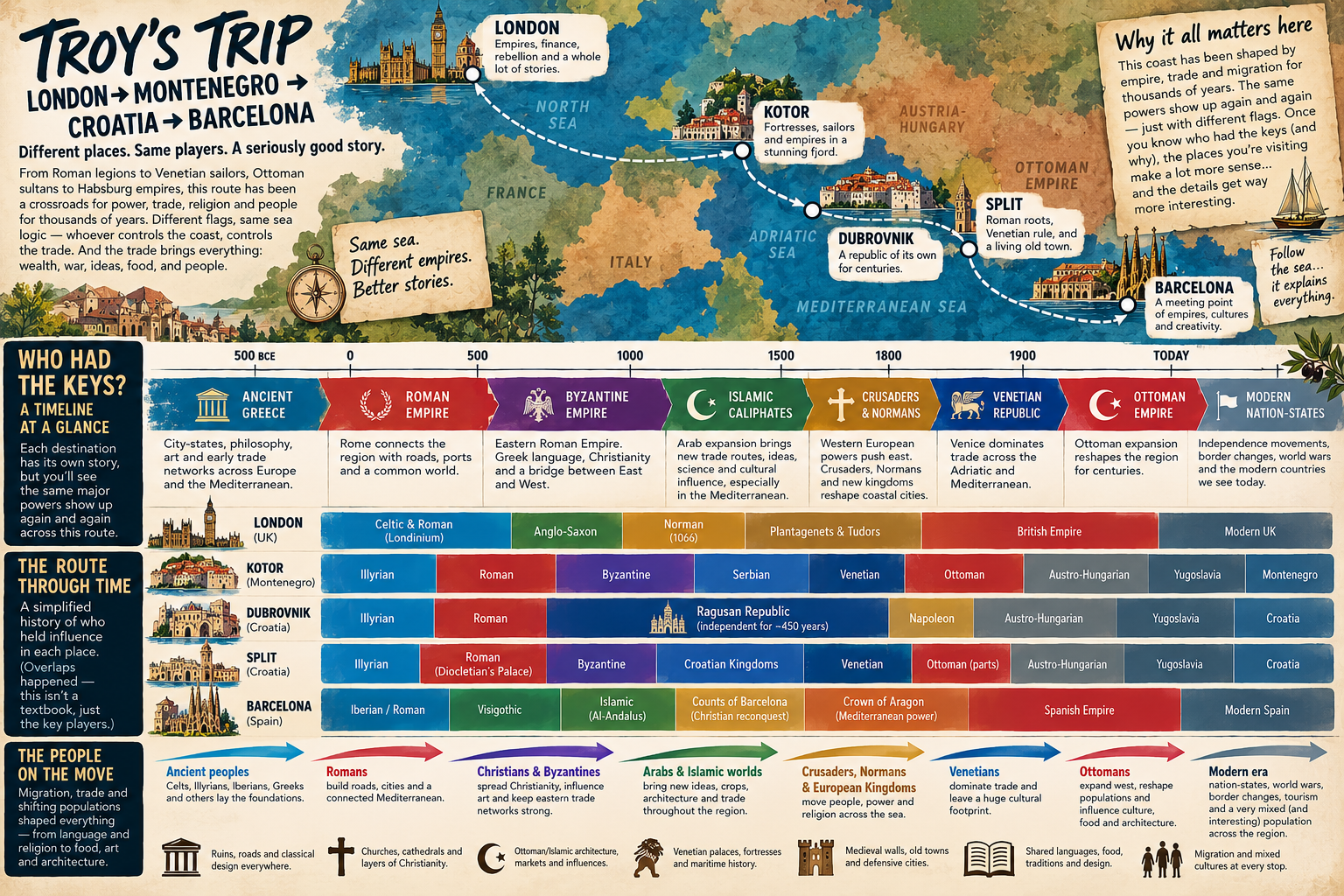
London to Barcelona. Roman to Ottoman to Venetian to Habsburg to modern. The same sea. Different empires. Better stories. You've followed the whole thread now. Barcelona is where it closes.
The Same Sea. Different Empires. Better Stories.
You started this route in London, where Roman walls hide under the City and the history is two thousand years of people inheriting the same city. You end it in Barcelona, where Rome is jammed into a courtyard, the medieval quarter is partly a renovation job and Gaudí's church has been under construction for 140 years and counting.
The whole route — London, Kotor, Dubrovnik, Split, Barcelona — follows one long argument about who controls the sea, the trade, and the stories that get told about both.
You've followed it from start to finish. Now go find a bar on Las Ramblas and tell someone what you learned. That's the whole point.
Map = where the story lives. Guide = what happened there before you arrived.