
The strange, surprising and very human stories hiding behind the places you’re already going.
Worth Repeating - Dubrovnik
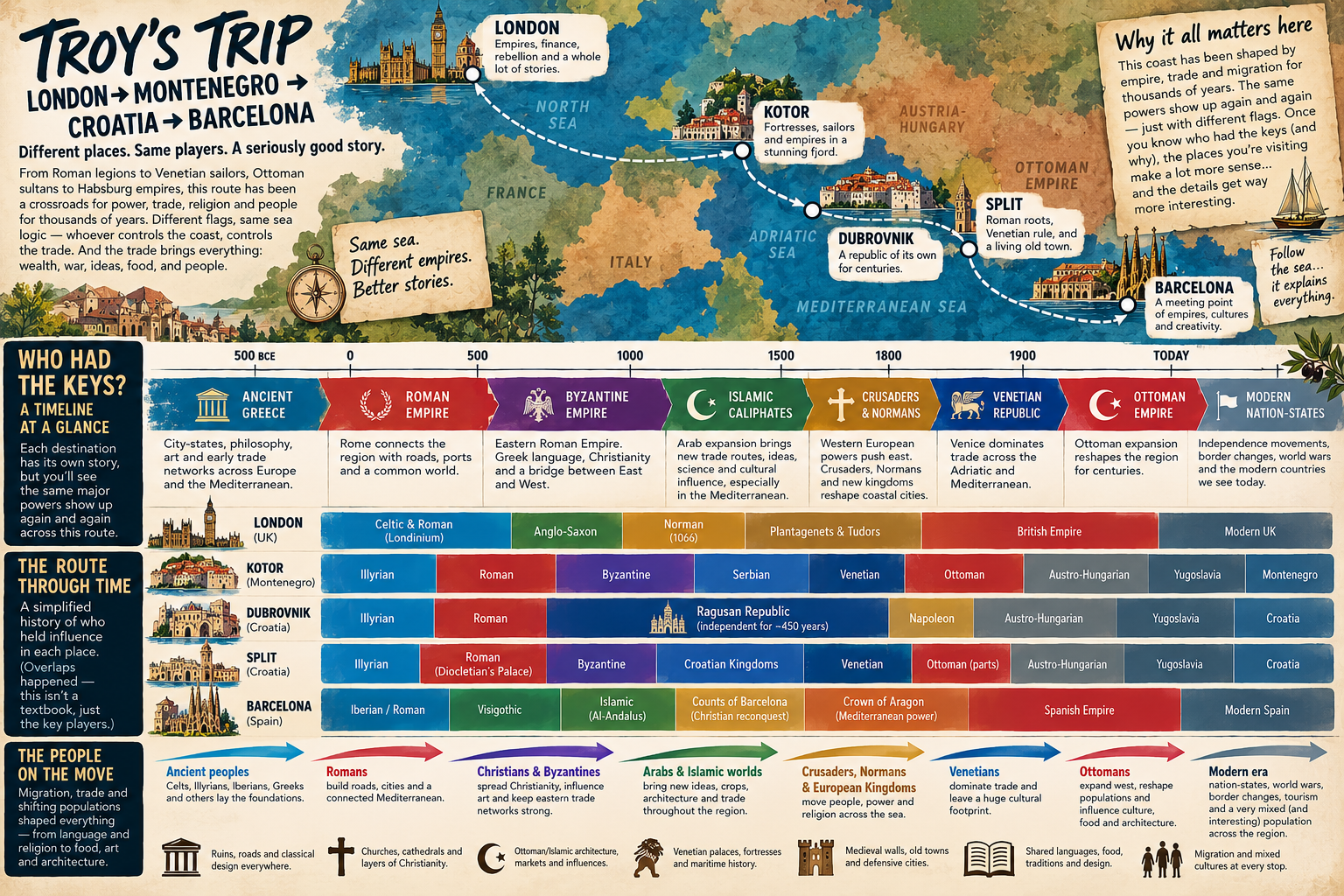
Republics, rivalries, ridiculous wealth and several centuries of refusing to pick a side.
Dubrovnik
Story Guide
A location-first companion to republics, relics, curses, corporal punishment and one very ill-advised gargoyle tradition.
Map = where the story lives.
Dubrovnik spent 450 years as its own republic beside much larger powers by mastering one extremely useful skill: staying useful to everybody. It didn't have the population or army to bully its neighbours. So it got very, very good at something else.
Guide = what happened there before you arrived.
Open the story where you are standing, tap the map link when you need the pin, and leave with one thing worth repeating over a glass of wine. The LIBERTAS motto isn't just a slogan. It was the operating system of an entire city-state.
Nine Places.
Nine Stories Worth Repeating.
Google Maps links and proper sources at every stop.
The Republic That Refused to Pick a Side
Dubrovnik survived for centuries beside much bigger powers by mastering one extremely useful skill: staying useful to everybody.
For much of its history, Dubrovnik was not simply a Croatian seaside town. It was the Republic of Ragusa — a small independent maritime state wedged between competing empires. It didn't have the population or army to bully its neighbours. So it got very, very good at something else.
Diplomacy as a Survival Strategy
Ragusa traded across the Mediterranean and into the Ottoman-controlled Balkans while maintaining relationships with Western European powers at the same time. Its ships moved goods. Its diplomats negotiated privileges. Its merchants made themselves useful.
And when the political weather changed, Dubrovnik generally tried very hard not to stand directly underneath it.
After breaking from Venetian control in 1358, the Republic developed its own government, courts, currency, diplomatic missions and foreign policy. It remained independent until Napoleon's administration abolished it in 1808.
For a tiny place surrounded by considerably larger neighbours, 450 years of political independence is a pretty impressive run.
Congratulations, You're in Charge.
For a Month.
Dubrovnik believed deeply in democracy, public service and making absolutely sure nobody enjoyed power for too long.
The Republic's head of state was called the Rector. Prestigious job. Beautiful palace. One small catch: your term lasted about one month.
Dubrovnik's ruling families deliberately rotated the position so quickly that building a personal political empire was rather difficult.
Forget Your Own Shit
Inside the Rector's Palace is one of the best political instructions ever carved into a government building:
That pretty much sums up the Republic's governing philosophy. The Rector wasn't supposed to use the office for personal advantage. The office belonged to Dubrovnik. And Dubrovnik was watching.
The Republic spread authority across councils, magistrates and short terms specifically to prevent one ambitious aristocrat from turning himself into a prince.
The Fortress Built Out of Spite
According to Dubrovnik tradition, Venice planned to build a fortress here. Dubrovnik found out. So Dubrovnik built one first.
Fort Lovrijenac sits on a rock outside Dubrovnik's western walls, rising roughly 37 metres above the sea. Local chronicles tell the story that Venice intended to fortify this exact spot in the 11th century. Dubrovnik supposedly learned about the plan and rushed construction.
By the time the Venetians arrived with their building materials, there was already a Dubrovnik fortress sitting on the rock. The story says it took three months.
Whether every detail of the legend happened exactly that way is difficult to prove centuries later. But the fortress itself contains an even better piece of evidence about how Dubrovnik thought.
We Trust You. Mostly.
The walls facing possible enemies are enormous. Depending on the side, they measure roughly four to twelve metres thick.
The wall facing Dubrovnik? About 60 centimetres.
That wasn't bad construction. It was deliberate. If the commander of Lovrijenac ever decided that possessing a giant fortress above the city made him king now, Dubrovnik's own artillery could blast straight through the thin wall from the city side.
Foreign invasion: twelve metres of stone. Local military coup: we have prepared for this.
The Saint Who Looks Suspiciously Well for His Age
There is a saint lying inside this church who appears to have handled the last 1,600 years remarkably well.
Meet St. Silvan. He lies beneath an altar in the Church of St. Blaise, displayed horizontally in what looks very much like a glass coffin. At first glance, the obvious reaction is: Is that an entire dead saint?
Sort of.
There Are Definitely Bones In There
The Dubrovnik Cathedral's own reliquary description identifies St. Silvan's display as bones placed inside a wax figure. Which means this is not a magically preserved intact body. But it is also very much not just a statue. There are human remains inside the extremely lifelike saint-shaped figure staring peacefully into eternity.
Dubrovnik, it turns out, has a considerable collection of holy body parts. The Cathedral Treasury holds elaborate reliquaries associated with saints including St. Blaise — including reliquaries for his head, arms and leg.
So St. Silvan is not really an outlier. He is simply the one with the best presentation.
Take Off Your Shirt on the Gargoyle
One of Dubrovnik's strangest traditions involves a tiny stone gargoyle, a slippery ledge and removing your clothes in public.
On the wall near the Franciscan Monastery is a small carved stone head known as the Maskeron. It wasn't originally designed for romance. It was part of the building's old drainage system. Humans improved upon this immediately.
The Dubrovnik Dating Challenge
Local tradition says that if you can:
- stand on the narrow stone projection,
- face the wall,
- keep your balance,
- take off your shirt,
- and then somehow put it back on again without stepping down…
…you'll have luck in love.
The stone has been polished smooth over generations, which makes the whole exercise considerably less reasonable than it already sounds.
People still try it. Because apparently 600 years of civilization has taught us very little.
Please Enjoy Dubrovnik.
Keep Your Nose.
The Republic of Dubrovnik had courts, prisons, fines and a highly developed legal system. It also occasionally removed parts of you.
Dubrovnik's 1272 Statute included several forms of physical punishment. Depending on the offence, sentences could include losing:
- a hand,
- an eye,
- both eyes,
- or your nose.
And these were not merely colourful threats written into an old law book. Archival evidence shows that mutilation continued to be used in Dubrovnik for centuries.
Your Nose Has Entered the Justice System
Some punishments were alternatives when offenders couldn't pay a financial penalty. Others were attached to particular offences. The Statute prescribed cutting off a woman's nose for certain theft offences. A female servant could also face the same punishment for secretly allowing a man into her employer's house. Other crimes could cost an offender a hand or an eye.
The point was not subtle. Punishments were often carried out publicly so everyone else could see exactly what happened when somebody ignored the rules.
Dubrovnik may have been sophisticated, wealthy and diplomatic. But medieval criminal justice was still very much medieval criminal justice.
The Republic Had a Professional Executioner
Dubrovnik did not outsource everything. For centuries, the Republic employed a professional executioner.
This was not a random guard handed an axe on a bad Tuesday. It was an actual state role. Records from the Dubrovnik archives trace professional executioners from the 14th through the 18th century, when the permanent office eventually disappeared.
Somebody Had to Do It
Across much of Europe, executioners lived on the social margins. Dubrovnik was a little different. Research into the Republic's records suggests the executioner carried less stigma here than in many other European cities. People generally seem to have regarded him as an official performing an ugly but necessary public service.
Which is an impressively bureaucratic way of describing a man whose job description included killing people.
The executioner also participated in the very public theatre of punishment. Executions weren't only meant to remove the offender. They were meant to make sure everyone watching understood the message.
The Merry Houses Were Not About Merriment
Dubrovnik eventually discovered that if something was going to happen anyway, you might as well regulate it.
By the late 19th century, Dubrovnik had legally tolerated prostitution. And the authorities were very interested in knowing exactly where it was happening. Public brothels began appearing in the 1890s, operating under police and medical supervision.
Then the Soldiers Arrived
One major reason was wonderfully practical. A new military barracks brought large numbers of soldiers into Dubrovnik. At the beginning of the 20th century, soldiers represented roughly 12% of the city's population. City officials became increasingly concerned about syphilis and other sexually transmitted infections.
So prostitution wasn't simply ignored. It was brought into a system involving:
- registered workers,
- medical examinations,
- police oversight,
- and licensed brothels.
Dubrovnik's main public brothel opened in 1897 and operated, in one location or another, until prostitution was formally prohibited in 1934. It even had waiting staff and food and drink service.
Apparently if you're going to run a municipal vice problem, you may as well offer hospitality.
The Monks Left.
The Curse Stayed.
When the Benedictine monks left Lokrum, legend says they did not go quietly.
The Benedictines had lived on Lokrum for centuries. The monastery is documented from 1023, and for generations the monks owned the island. Then, at the end of the 18th century, the monastery was abolished and the monks were forced to leave. According to legend, they had feelings about this. Strong ones.
Bring Candles. Hold Them Wrong.
On their final night, the monks supposedly walked around the island in a solemn procession. They wore their hoods pulled low. They chanted prayers. And they carried lit candles upside down, allowing the wax to drip over their hands as they cursed anyone who dared own Lokrum after them.
That curse apparently applied to all future possessors of the island.
Which is quite the closing statement.
History Kept Handing It Good Material
Later owners suffered enough tragedies that the legend refused to die. The Habsburgs became particularly associated with it after Archduke Maximilian purchased Lokrum in 1859 and built a summer residence there. Maximilian later became Emperor of Mexico. That went badly. He was executed in 1867.
And every fresh Habsburg disaster gave Dubrovnik another reason to whisper: the monks did warn you.
The Pattern Is the Point.
Liberty, Limits and Lunacy.
Everything in Dubrovnik connects. Here's the chain.
The Republic
450 years of independence by being useful to everyone and loyal to no one in particular. The motto wasn't decoration — it was the operating system.
The Architecture of Distrust
One-month Rectors. Thin fortress walls facing your own city. Inscriptions reminding rulers to mind the public business. A government designed from the ground up to prevent ambition from becoming tyranny.
The Strange and the Sacred
Wax saints with bones inside. A drainpipe turned into a love-luck challenge. Relics collected on an industrial scale. A city that managed both deep piety and considerable weirdness simultaneously.
The Uncomfortable History
Noses removed by statute. A professional executioner on the payroll. Regulated brothels with table service. Dubrovnik kept meticulous records of all of it. Which is why historians love it.
Dubrovnik Kept the Receipts for Everything
That is the thing about a republic built on trade and law. You write things down. You keep the records. You archive the Statute. You file the medical inspection lists. You carve the Latin instructions into the walls so nobody can claim they didn't know.
The result is a city that is unusually legible across centuries. The stories aren't speculation. They're documented. The walls, the inscriptions, the archives, the monastery on the cursed island — the evidence is all still here.
Walk slowly. Read the walls. And maybe don't buy property on Lokrum.
Map = where the story lives. Guide = what happened there before you arrived.