
The strange, surprising and very human stories hiding behind the places you’re already going.
Worth Repeating - kotor
Mountains, mutiny, maritime swagger and an unreasonable number of people trying to own this coastline.
Montenegro
Story Guide
A location-first companion to walls, mutiny, cats, saints, submarines and several questionable infrastructure decisions.
Map = where the story lives.
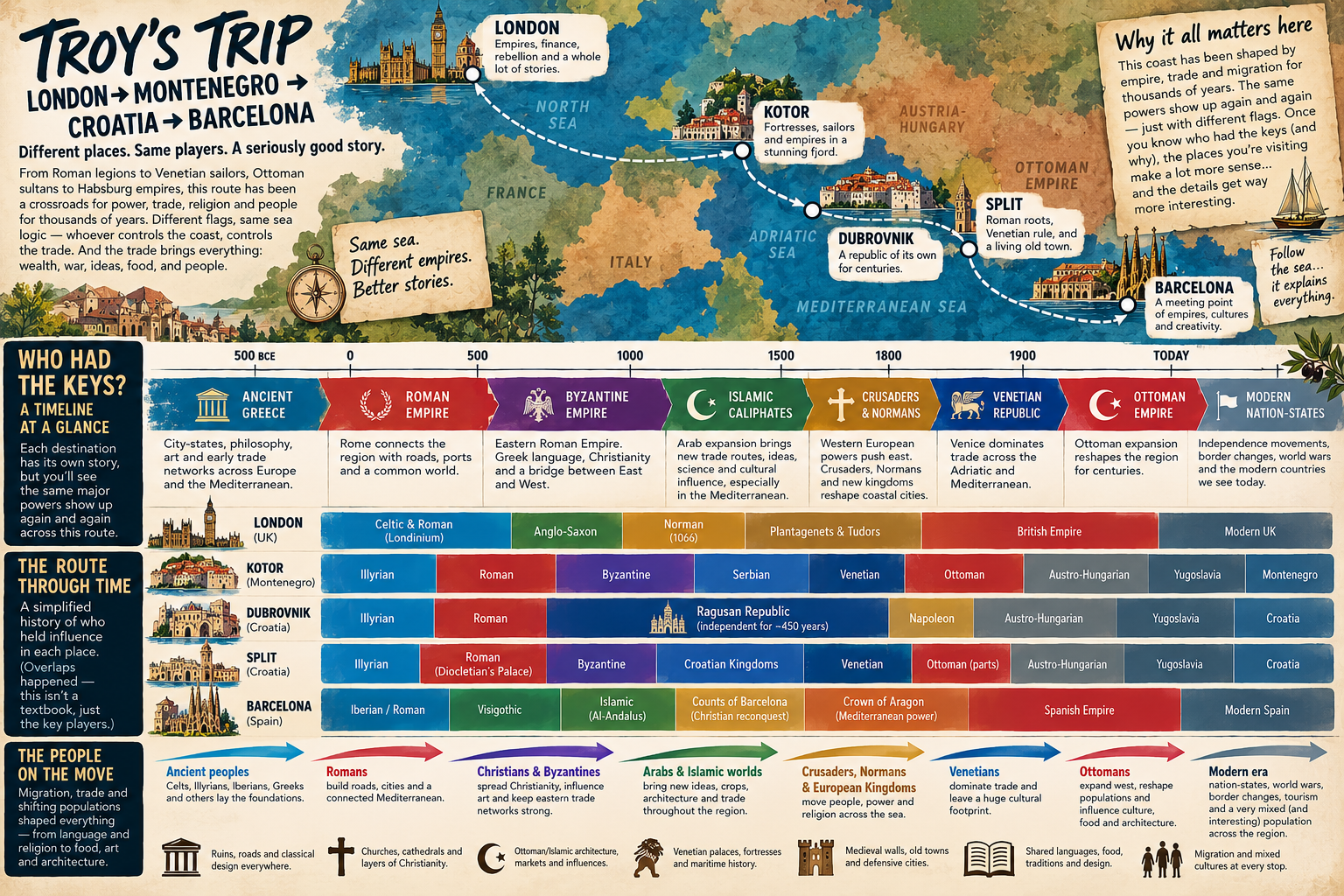
Montenegro has spent centuries wedged between mountains, sea routes and much larger powers with very strong opinions about who should be in charge. This is not the complete history of Montenegro. Thank God.
Guide = what happened there before you arrived.
The recurring theme is pretty simple: useful harbour, difficult mountains, stubborn people. Empires came and went. The walls stayed. The cats appear to have inherited the place.
Ten Places.
Ten Stories Worth Repeating.
Google Maps links and proper sources at every stop.
Apparently the Mountain Needed a Wall Too
Most cities build a wall around themselves. Kotor looked at the mountain behind it and decided to keep going.
Kotor sits in an annoyingly useful location: a protected Adriatic harbour with access inland toward the Balkans. That made it valuable for trade. It also meant that for centuries, powerful neighbours kept developing opinions about who should control it.
The answer was stone. A lot of stone.
Not Enough Wall
Kotor's fortifications rise from the waterfront and zigzag up the mountain toward the fortress above the city. The defenses developed over centuries, but the Venetian Republic left an especially large mark while Kotor formed part of its maritime defensive network.
Stand somewhere inside Old Town and look straight up. The walls just keep going.
It's one of those things that looks slightly ridiculous until you realize the people who built it genuinely expected armies to show up. And frequently, they did.
Venice Was Playing the Long Game
Kotor's defenses weren't some isolated medieval engineering project. They were one piece of a huge Venetian system protecting ports, sea routes and territory stretching along the Adriatic.
That network is now important enough that Kotor forms part of a UNESCO World Heritage listing specifically for Venetian defensive works.
So those walls aren't scenery. They're the remains of a very expensive argument over who controlled the Adriatic.
Congratulations. You Are Visiting the Cats.
Kotor technically belongs to Montenegro. Operational control appears to have been transferred to the cats.
You'll notice them quickly. Cats asleep on ancient stone steps. Cats underneath café tables. Cats in doorways. Cats watching tourists with the exhausted expression of someone who has seen four cruise ships arrive before breakfast.
Nobody appears particularly bothered by this arrangement.
The Cats Have Branding Now
There are plenty of stories about how Kotor became a cat town, usually involving ships, sailors and cats coming ashore from trading vessels. That part gets harder to prove.
What we can prove is that modern Kotor has completely embraced them. Montenegro's national tourism organization calls Kotor a city of cats. There are cat souvenirs everywhere, locals leave food and water around town and the cats have even acquired their own museum.
Yes. There Is a Cat Museum.
The Cats Museum contains old postcards, illustrations, stamps and books featuring cats. It is exactly the kind of institution that happens when an entire town collectively decides: Fine. This is our thing now.
So don't worry about finding the cats. They'll find you.
The Town That Had to Be Put Back Together
Kotor looks like it has simply been sitting here for centuries. That is not what happened.
On April 15, 1979, a major earthquake struck the Montenegrin coast. Kotor was hit brutally hard. Homes, churches, palaces and historic buildings were damaged or destroyed, and the historic region was placed under extraordinary preservation pressure.
UNESCO Put It on Two Lists at Once
Six months after the earthquake, the Kotor region was added to the UNESCO World Heritage List. That was the good list. At exactly the same time, it was placed on the World Heritage in Danger list because so much of the historic city had been damaged.
Then came the slow work. Engineers, architects, conservation experts and craftspeople spent years rebuilding and restoring what could be saved. The region stayed on the danger list until 2003.
Old Because Someone Made Sure It Stayed Old
That changes how Kotor feels. You aren't simply wandering through something that miraculously survived every century untouched.
You're walking through something people actively chose to save. Buildings were stabilized. Churches repaired. Stonework reconstructed. History didn't just survive here. Somebody picked it up off the floor and put it back together.
The Day the Sailors Said Screw This
Today the Bay of Kotor is yachts, mountains and aggressively pretty water. In 1918, it was full of warships and seriously pissed-off sailors.
During the First World War, this bay was known as Cattaro and served as a major Austro-Hungarian naval base. By early 1918, the war had been grinding on for years. Conditions aboard many ships were miserable. Food was poor. Sailors resented harsh discipline and the much better treatment enjoyed by officers.
Then, on February 1, things finally snapped.
The Fleet Joined In
Mutiny spread through the fleet. Sailors seized control aboard vessels, raised red flags and began making demands that ranged from better treatment to political reform and an end to the war.
For a few days, the Austro-Hungarian Empire had a fairly serious problem: the navy was sitting in one of its most important bases. And the navy wasn't interested in navying.
It Didn't End Well
Loyal forces arrived. The uprising collapsed after three days. Hundreds of sailors were arrested and four of the mutiny's leaders were eventually executed.
So somewhere during the boat ride, stop looking at the mountains for ten seconds. Replace the tour boats with battleships. Add red flags. And imagine an entire harbour realizing the guys operating the warships had finally had enough.
First They Built the Church.
Then They Kept Building the Island.
That tiny island off Perast isn't entirely natural. Generations of people helped put it there.
According to local tradition, sailors discovered an image of the Madonna and Child on a reef offshore from Perast. A church eventually followed. But there was a practical problem. A reef is a fairly inconvenient place to build a church. So people started adding rocks.
Bring a Rock
Over generations, locals enlarged the site by dumping stones into the water and adding material around the reef. The result became the island now known as Our Lady of the Rocks — Gospa od Škrpjela.
And wonderfully, Perast never completely stopped. Every July 22, the town celebrates the Fašinada. Boats are decorated, loaded with stones and tied together before heading toward the island at sunset. Then the rocks go overboard.
The Construction Project Is Still Open
Think about that for a second. This isn't simply an old tradition commemorated with costumes and speeches. They're still performing the basic act that created the island.
More rocks. More island. Several hundred years later. Very few construction projects have that kind of schedule.
The Madonna Apparently Entered the Battle
There was an Ottoman attack. There was a miraculous icon. Then local storytelling did what local storytelling does best.
In 1654, Ottoman forces attacked Perast. The town was then under Venetian control, and the fighting came from both land and sea. The population took shelter while defenders prepared for an attack from a force considerably larger than their own. Meanwhile, something important was being moved.
Protect the Madonna
Our Lady of the Rocks held a revered painting of the Madonna and Child. As the attack began, defenders moved the image from the exposed island into Perast's fortress. Perast survived the attack.
That's the historical part. Then comes the better story.
Local legend grew around the Madonna helping save the town. Some versions say she appeared during the fighting and blinded the attackers.
History and Legend Can Share a Beer
Did the Battle of Perast happen? Yes. Was the Madonna's image tied closely to the town's memory of the battle? Also yes. Did Mary personally deploy tactical pocket sand against the Ottoman army?
We are going to mark that one local legend and let Perast have its fun.
The Mountain Has a Submarine Garage
Just when the Bay of Kotor starts feeling very medieval, somebody drives the boat into a Cold War bunker.
During the Yugoslav era, this bay wasn't simply beautiful. It was military infrastructure. Its narrow entrance, deep protected water and surrounding mountains made it extremely useful to the Yugoslav Navy. So somebody came up with a wonderfully Cold War solution to protecting naval vessels: put them inside the mountain.
Hide the Boats
Tunnels were blasted directly into the limestone cliffs around the Luštica Peninsula. They were designed to conceal and protect submarines and smaller warships from observation and attack.
Today, former military tunnels survive around the outer bay and boat tours can still nose right inside them. It is dark. It is deeply weird. And it changes the entire personality of the bay.
Apparently Every Century Needed Defenses
By this point Montenegro has given us: Venetian fortress walls. Austro-Hungarian battleships. A naval mutiny. And submarines parked inside mountains.
Beautiful scenery. Deeply suspicious residents.
Montenegro Needed a Pool Table
Petar II Petrović-Njegoš was a ruler, bishop, philosopher and poet. Naturally, what Montenegro really needed was billiards.
Njegoš is one of the giant figures of Montenegrin history. He was both Montenegro's political ruler and its prince-bishop. He wrote poetry and philosophy. He tried to modernize a small mountain state surrounded by much bigger powers. And at some point he apparently decided the modernization program required a pool table.
Special Delivery From Kotor
Njegoš ordered a billiard table from Vienna. It arrived through Kotor. Then came the logistical issue. Cetinje is on the other side of the mountains. This was the 1800s. There was no IKEA truck.
According to Montenegro's tourism material, young Montenegrin men carried the billiard table from Kotor to Cetinje on their shoulders. That is commitment to recreational infrastructure.
The Table Named the House
The billiard table was reportedly the first — and for a time the only — one in Montenegro. It caused such a stir that Njegoš's residence became known as Biljarda. Literally: The Billiard House.
The man wrote some of Montenegro's most important literature and helped shape the country's national identity. And his house got named after his pool table. History is magnificent.
The King Who Used Weddings as Foreign Policy
Montenegro was tiny. King Nikola had twelve children. Suddenly Europe was full of relatives.
Nikola I ruled Montenegro during a period when the country was trying to hold its own among significantly larger European powers. Montenegro didn't have enormous wealth. It didn't have a giant army. It did, however, have a very large royal family. Nikola and Queen Milena had twelve children. And several of those children married extremely well.
Dad Has Connections
Their daughters married into royal and aristocratic families across Europe, including the ruling houses of Italy and Russia. Those marriages gave tiny Montenegro personal connections inside some of Europe's most powerful courts.
Nikola became famous enough for this particular skill that he acquired a nickname: The Father-in-Law of Europe.
Not bad for the ruler of a country most Europeans would have struggled to find on a map.
Networking Before LinkedIn
Royal marriages weren't just romantic arrangements. They were politics. Family ties created access, alliances and influence. For Montenegro, that mattered.
So when you walk around little Cetinje and wonder why it has royal palaces, old embassies and outsized diplomatic history, remember: this tiny mountain kingdom had relatives everywhere.
Montenegro Tried Golf.
The Ground Objected.
In 1906, Cetinje decided it needed golf. Nobody appears to have asked the geology.
By the early twentieth century, Cetinje was a tiny royal capital doing its best impression of a fashionable European city. There were embassies. Royal residences. Tennis. Cycling. And in 1906, Montenegro's first golf club. Very civilized. There was just one fairly obvious problem.
Have You Seen Montenegro?
Cetinje sits in a karst landscape. Karst geology is famous for limestone formations, depressions, underground drainage and — importantly for golfers — sinkholes.
Montenegro's own tourism material raises the obvious question about the old golf course: nobody recorded just how successful the game could possibly have been when there were so many pits and sinkholes available for golf balls to vanish into.
Which is an extraordinary sentence to find in tourism literature.
Golf Ball, Meet Balkans
Somewhere in Cetinje in 1906, somebody must have taken a beautiful drive down the fairway. The ball bounced once. Twice. And disappeared into the earth.
Montenegro wins.
Montenegro Is Small Enough
to See the Layers
The pattern runs through everything. The stories connect. Here's the chain.
Kotor
Explains why empires wanted this coast: a protected harbour, trade routes and walls built by people who expected trouble. Then cats.
The Bay
Adds sailors, mutiny and submarines. Beautiful scenery. Deeply suspicious residents.
Perast
Adds faith and an island built one rock at a time. And a battle the Madonna allegedly settled personally.
Cetinje
Takes you inland, where a tiny mountain state built a royal capital, networked its way into Europe and somehow found room for a billiard table and a deeply questionable golf course.
You Do Not Need to Remember the Dates
Remember the pattern: useful harbour, impossible geography, stubborn humans.
The walls went up because armies kept arriving. The cats stayed because nobody stopped them. The billiard table crossed a mountain because a poet-bishop wanted one. The golf balls fell into sinkholes because Montenegro is Montenegro.
The stories here aren't separate. They're the same story told in different centuries with different costumes.
Map = where the story lives. Guide = what happened there before you arrived.