
The strange, surprising and very human stories hiding behind the places you’re already going.
Worth Repeating - Split
Roman emperors, palace squatters, collapsing empires and a city that simply moved into the ruins.
Split
Story Guide
A location-first companion to an emperor who grew cabbages, a palace people moved into, a sphinx older than Rome and a street called Let Me Pass.
Map = where the story lives.
Split is built inside a Roman emperor's retirement palace. Not near it — inside it. Apartments, restaurants, a cathedral in his mausoleum. The Roman world didn't end here. People just moved in and kept going.
Guide = what happened there before you arrived.
Open the story where you are standing, tap the map link when you need the pin, and leave with one thing worth repeating over a glass of pošip. The layers in Split aren't metaphorical. They're structural.
Twelve Places.
Twelve Stories Worth Repeating.
Google Maps links and proper sources at every stop.
The Emperor Who Actually Retired
Roman emperors generally left office by dying. Diocletian tried something considerably more radical: retirement.
Diocletian ruled the Roman Empire for more than twenty years before voluntarily giving up power in AD 305 and retreating to the enormous palace he had built beside the Adriatic. Ancient writers singled him out for doing something almost unheard of: going from emperor back to private citizen.
Apparently the Cabbages Were Excellent
Later tradition says former co-emperor Maximian tried to persuade Diocletian to return to politics. Diocletian's famous response was essentially: You should see the cabbages I'm growing.
Whether every detail of the cabbage story happened exactly as later writers told it is harder to prove, but Diocletian's retirement and gardening became part of his legend. One of the most powerful men in the Roman world apparently looked at politics, looked at his vegetable garden and chose cabbages.
The Palace Nobody Turned Into a Museum
The strange thing about Diocletian's Palace isn't that it survived. It's how.
After the Roman world changed around it, people moved inside the old imperial complex and started adapting it. Houses appeared against Roman walls. Medieval streets formed through imperial rooms. Churches replaced temples. Shops, apartments and restaurants followed.
Split didn't preserve the palace. Split moved into it.
The Garbage Saved the Basement
The huge substructures underneath Diocletian's apartments survived partly because later residents used sections of them as household dumping grounds. Oddly enough, centuries of accumulated rubbish helped preserve the Roman spaces below.
Because the basement layout closely mirrors the vanished imperial apartments above it, archaeologists can use the surviving rooms to understand what Diocletian's residence looked like.
One of the world's great Roman archaeological sites was partially protected by generations of people throwing garbage into the basement.
The Sphinx Was Ancient Before Split Was Roman
Diocletian wanted his palace to look impressive, so naturally he imported antiques from Egypt.
Standing beside the Peristyle is an Egyptian granite sphinx roughly 3,500 years old. Diocletian had Egyptian sphinxes brought to his palace during its construction. Which means the sphinx you're looking at was already more than a thousand years old when the Romans installed it here.
The Emperor's Stage
The Peristyle wasn't just a pretty courtyard. Diocletian appeared here ceremonially as an emperor associated with Jupiter. Subjects approached him kneeling, kissing his robe or lying completely prostrate before him.
Today? People sit on the same stones drinking coffee.
The Christians Took the Emperor's House
There is some spectacular historical irony sitting in the middle of Split.
Diocletian built this structure as his mausoleum. His reign also produced one of the Roman Empire's major persecutions of Christians. After Christianity became dominant, the emperor's mausoleum was converted into a cathedral dedicated to Saint Domnius — Sveti Duje — traditionally remembered as a Christian martyr killed during Diocletian's persecution.
The emperor's tomb effectively became the church of one of his victims.
Jupiter Got Evicted Too
Nearby, Diocletian's Temple of Jupiter was later converted into a Christian baptistery. The new religion didn't need to demolish Roman Split. It simply changed the tenants.
Stand inside the Cathedral today and you are standing in the building Diocletian built to hold his own body. The irony isn't metaphorical. It's architectural.
Let Me Pass
Some cities have streets named after kings and battles. Split has one named after being mildly annoyed.
Beside the Temple of Jupiter is one of Split's narrowest lanes. Its name is:
And Then There's the Clock
Walk toward the Iron Gate and look up. The old clock doesn't use the usual twelve-number face. It displays all 24 hours.
Because apparently Split looked at normal European timekeeping and thought: We can make this slightly stranger.
Within a few minutes you can find a street called Let Me Pass and a clock with 24 numbers. Excellent municipal energy.
The Fish Market With No Flies
Walk into Split's fish market and something feels slightly wrong.
There are tables covered with sardines, mackerel, shellfish and fresh fish. But famously: almost no flies. The local explanation is the sulphur smell coming from the nearby thermal springs. Apparently the flies want nothing to do with it.
The Emperor Liked the Sulphur Too
Those same sulphur springs have long been connected with Diocletian's decision to build here, traditionally because of his health problems later in life.
So there's an oddly tidy line running through Split history: Roman emperor likes sulphur. City grows around palace. Fish market appears. Flies leave.
Split may have discovered the Mediterranean's greatest pest-control system: make the neighbourhood smell faintly like rotten eggs.
The Sport Where the Ball Is Not Allowed to Get Wet
Split invented a beach sport with one wonderfully stupid problem.
Picigin is played standing in shallow water. Players bat a small ball between them using their hands and try to keep it from touching the sea.
There's no net. No complicated scoring system is required for the casual version. The glory is in keeping the rally alive — preferably by launching yourself dramatically through the air after a ball that absolutely does not deserve this level of commitment.
Bačvice is the spiritual home of the game. Go in the morning. Watch locals play for an hour. The commitment is both baffling and deeply admirable.
The Picigin Rule
Picigin is essentially: stand in water and work extremely hard to prevent the ball from touching the water.
In 2009, picigin was added to Croatia's list of intangible cultural heritage. Which is an impressive destination for a game that is basically competitive splash avoidance.
Split's Other Religion
To understand Split properly, you eventually have to talk about Hajduk.
Hajduk Split was founded in 1911 by students from Split who were studying in Prague. But the club became much more than football.
During WWII, Hajduk became associated with the anti-fascist resistance and played a famous 1944 match against a British Army team in liberated Bari in front of more than 40,000 spectators.
After the war, the new Yugoslav government invited Hajduk to move to Belgrade and become the official army club. Hajduk refused.
Then the Fans Arrived
In 1950, supporters created Torcida, inspired by the intense Brazilian crowds they had heard about during that year's World Cup. Hundreds arrived for a crucial match against Red Star carrying bells, rattles and sirens. Hajduk won 2–1.
Authorities responded with arrests, beatings and disciplinary action, and Torcida's public activities were suppressed for years. One of Europe's oldest organized supporter groups lasted approximately one day before annoying the government. Very Split.
The Jewish Tower
The Roman palace became shelter for far more communities than Diocletian could ever have imagined.
Jewish life in the Split area reaches back deep into antiquity. A Jewish community later developed inside the palace itself, and Split's synagogue grew out of medieval buildings incorporated into the old Roman fabric.
The Ghetto Doors
By the 18th century, gates separated the Jewish quarter from surrounding streets and were closed at night. Some old stone doorways still contain holes where mezuzahs once sat.
The Tower
The detail worth remembering is the northwest corner tower. It became known as the Jewish Tower because members of Split's Jewish community helped guard that section of the city against Ottoman attack.
Henry VIII Was Taking Marriage Advice From a Guy in Split
Marko Marulić is one of Croatia's literary giants. This story gets better.
Born in Split in 1450, Marulić became an influential Renaissance humanist and is widely regarded as the father of Croatian literature. His books circulated across Europe. One surviving copy of his Evangelistarium belonged to Henry VIII and still contains the English king's handwritten notes.
Among the topics that apparently caught Henry's attention? Choosing a spouse.
Results may vary.
Marulić Wasn't Exactly Boring Either
A much less certain local legend says Marulić and a friend from the Papalić family shared the same lover and took turns visiting her. The story ends with murder, punishment and Marulić supposedly fleeing to a monastery.
It's a legend, not established biography — which may actually make it more Split.
Roko & Cicibela
Split has emperors, bishops and famous writers. It also remembers two broke people who lived in a boat.
Matejuška was the harbour of Split's working fishermen. Boats left from here every day to bring food home to families living in nearby Veli Varoš. And among its most beloved stories is Roko and Cicibela.
They were an impoverished couple said to have lived together aboard a small fishing boat, surviving on occasional work and not much else. What they apparently did have was each other.
The Harbour Today
Today Matejuška is still where people gather outside with drinks, sit along the harbour and let the evening happen. The story of Roko and Cicibela stuck not because it is grand, but because it is human. Two people with almost nothing, remembered by a city that also gave us imperial palaces.
Some cities immortalize kings. Split also remembers two broke lovers who lived in a fishing boat.
The Fountain That Became Politically Inconvenient
Sometimes the strangest thing about a monument is why it isn't there.
In the late 19th century, Split built an elaborate monumental fountain decorated with sea horses, sirens, dolphins and figures representing commerce, industry and civic progress. Local citizens helped finance it. Then politics kept changing.
The Fountain's Problem
During WWII, Italian fascist authorities connected the fountain with their claims over Dalmatia. After the war, the new communist authorities associated it with the fascist period. So in 1947, they demolished it.
Split Was Not Particularly Impressed
For many locals, it wasn't an Italian fountain or a communist fountain or a fascist fountain. It was simply their fountain. Decades later, campaigns have continued to bring it back.
Split lost a spectacular fountain because successive governments kept assigning political opinions to plumbing.
Split Is History
Still Living Inside History
The layers connect. Here's the thread.
The Palace
Built as a retirement home for one man. Became a city. The basement filled with garbage and was saved by it. The mausoleum became a cathedral dedicated to one of its builder's victims. People are still living inside the Roman walls today.
The Strange Details
An Egyptian sphinx older than Rome. A street called Let Me Pass. A clock with 24 numbers. A fish market with no flies because of sulphur springs. A beach sport where the point is keeping the ball out of the water you're standing in.
The Human Stories
A football club that refused to move to Belgrade. A literary giant whose annotated book ended up in Henry VIII's library. Two broke lovers who lived in a boat and got remembered anyway.
The Missing Things
A spectacular fountain demolished because someone thought it had political opinions. An absence that became its own kind of monument. Split keeps those receipts too.
Split Didn't Preserve History. It Kept Living In It.
Most historic sites are protected behind glass or rope barriers. Split is different. The Roman walls are somebody's back garden. The imperial mausoleum is the parish church. The basement under the emperor's apartments is a venue.
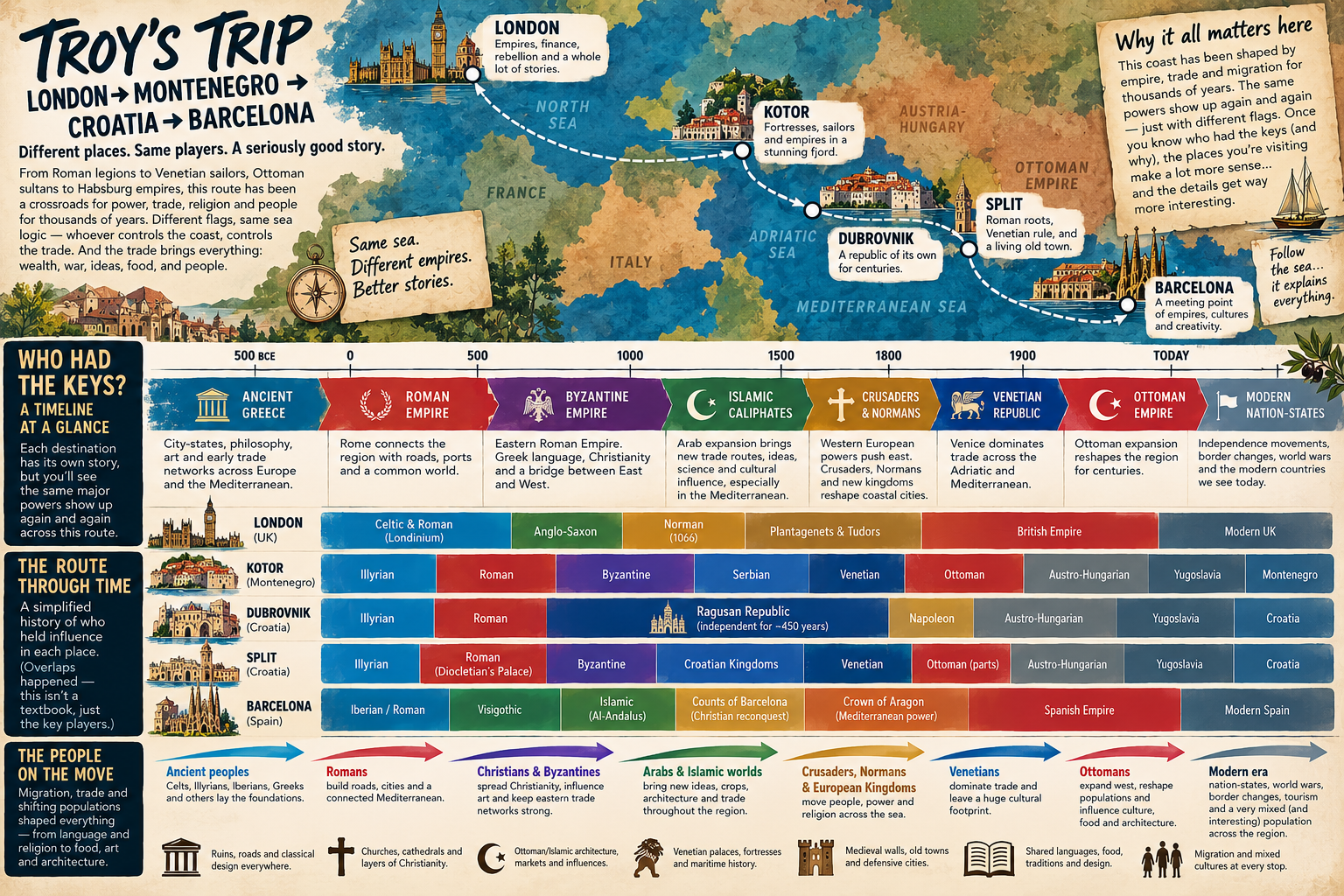
That's the thing about a city that moved into a palace instead of turning it into a museum. The history didn't stop when Rome fell. It kept accumulating — medieval, Ottoman, Venetian, Habsburg, Yugoslav, modern Croatian — layer by layer, on the same stones.
Walk slowly. Look up. Read the walls. The cabbage story is true in the ways that matter.
Map = where the story lives. Guide = what happened there before you arrived.